
English| EUR
Suggested for you
More currencies
Choose a language
Banff National Park shelters one of North America's most diverse mountain ecosystems, where alpine meadows, dense forests, and glacial valleys create habitat for more than 50 mammal species. Understanding which animals live here—and where to find them—transforms a mountain drive into a wildlife encounter.
Quick answer
Banff National Park is home to 53 mammal species, including grizzly bears, black bears, elk, moose, bighorn sheep, mountain goats, wolves, cougars, and lynx. The park also hosts over 280 bird species and numerous smaller mammals like hoary marmots and pikas. Large ungulates like elk and bighorn sheep are frequently spotted along roadways and in valley bottoms, while predators such as wolves and grizzlies occupy backcountry ranges.
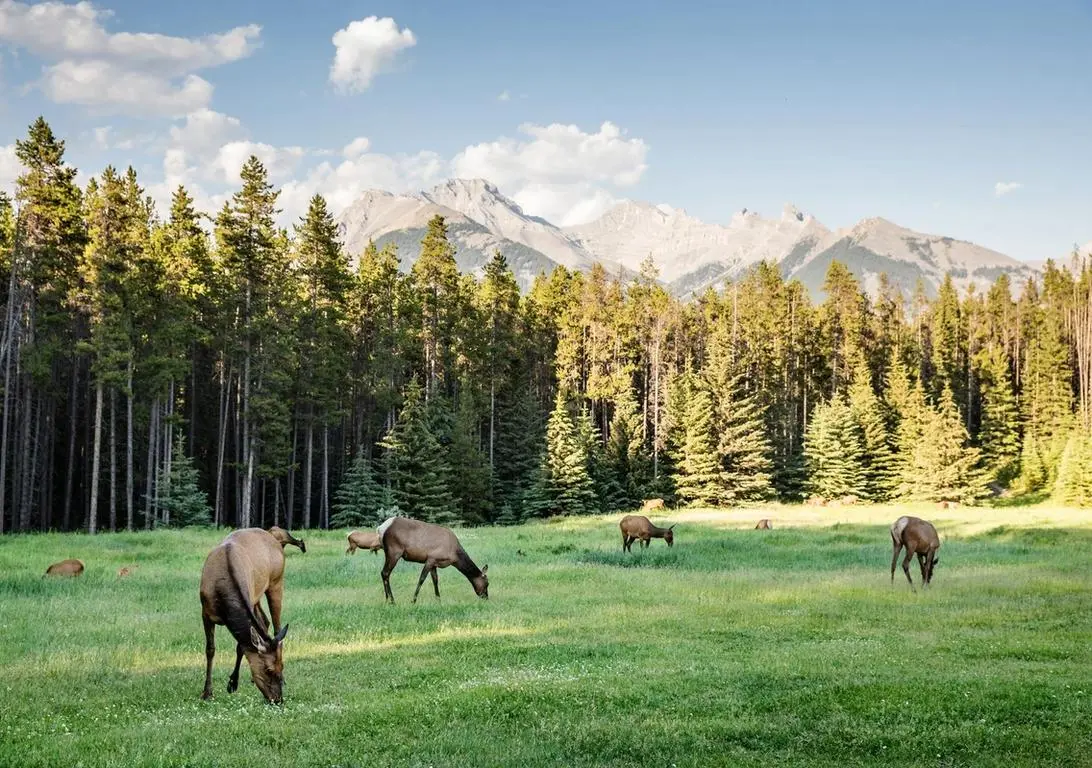
The park's 6,641 square kilometers span four distinct life zones—montane valley floors through alpine tundra—each supporting specialized wildlife communities. This vertical stratification means what animals live in Banff National Park depends partly on elevation: elk and deer dominate the valleys, while mountain goats cling to cliffs above treeline. Grizzly bears and black bears share the park but occupy different niches. Grizzlies prefer open alpine slopes where they dig for ground squirrels and graze on sedges; black bears favor dense forest edges rich in berries. Both species enter hyperphagia in autumn, consuming up to 20,000 calories daily before denning. Elk congregate in massive herds during the September rut, when bulls bugle across meadows near the Bow Valley Parkway. Bighorn sheep descend to mineral licks along the Icefields Parkway in spring, while moose browse willow thickets in wetland pockets throughout the park. The predator guild includes wolves, cougars, coyotes, and Canada lynx, though sightings remain rare due to nocturnal habits and low population densities. Wolves recolonized the park naturally in the 1980s and now regulate elk populations through pack hunting. Smaller carnivores like wolverines and fishers occupy remote subalpine forests, while river otters patrol the park's waterways. Bird diversity peaks during spring migration when warblers, thrushes, and sparrows flood montane forests. Year-round residents include gray jays, ravens, and three woodpecker species. Raptors such as golden eagles and peregrine falcons nest on cliff faces, hunting marmots and pikas in talus fields. The Banff wildlife viewing guide emphasizes early morning and dusk as prime activity windows, when animals move between feeding and resting areas along predictable routes. Conservation efforts focus on maintaining wildlife corridors beneath the Trans-Canada Highway, where 44 crossing structures allow safe passage for animals ranging from bears to salamanders. These engineered solutions reduce vehicle collisions by 80 percent while preserving genetic connectivity across fragmented habitats.
“The park's vertical life zones mean wildlife distribution shifts with elevation—valley elk give way to alpine goats within a few kilometers of climbing.”
Banff National Park supports a diverse range of megafauna and smaller mammals adapted to the Canadian Rockies. Understanding these species provides context for the ecosystem observed during wildlife tours.
Banff National Park is home to 53 known species of mammals, ranging from small rodents to large ungulates and carnivores. [1]
Both grizzly and black bears inhabit the park, often found in lower elevation valleys and subalpine meadows. Grizzly bears are identified by a shoulder hump and dished facial profile. [2]
Elk are frequently seen in the townsite and along the Bow Valley Parkway. They are the most commonly spotted large ungulate in the park. [3]
Cougars, also known as mountain lions, live throughout the park but are rarely seen due to their secretive and solitary nature. They typically hunt deer and elk in forested areas. [4]
Gray wolves exist in packs within Banff, playing a critical role in controlling ungulate populations. They are wide-ranging animals that cover large territories. [5]
Moose are typically found in marshy areas, willow thickets, and along lakeshores. They are solitary animals known for their size and distinct antlers in males. [6]
Bighorn sheep are commonly seen on rocky slopes and near the park's east gates. They are well-adapted to steep, rugged terrain where they graze on grasses and sedges. [7]
To maximize wildlife viewing opportunities, visitors should adhere to the best arrival window of 06:00–09:00. This timeframe aligns with peak animal activity and helps avoid peak traffic within the park.
—
Animals are most active during these low-light periods, increasing sighting frequency significantly for diurnal species.
Cool, variable 5°C to 18°C
Wildlife emerges from winter dens and migrates to lower valleys for fresh vegetation.
Crisp, cool 2°C to 15°C
The elk rut occurs during this period, resulting in higher activity levels and vocalizations throughout the park.
Verdict: Plan your visit for dawn or dusk during the months of May, June, September, or October to coincide with the best arrival window of 06:00–09:00.
Banff's wildlife remains wild and unpredictable. Proper conduct protects both visitors and animals from dangerous encounters and prevents habituation that can lead to animal removal or euthanasia.
Banff National Park is located in Improvement District No. 9, AB, Canada. The most accessible approach for visitors is via the Trans-Canada Highway (Highway 1), which runs directly through the park.
Trans-Canada Highway (Highway 1) to Banff exit
Roam Transit to Banff town centre
Trans-Canada Highway (Highway 1) to Banff
Plan your arrival for the 06:00–09:00 window to avoid peak traffic and increase chances of wildlife sightings. Ensure you have your daily adult conservation fee ready upon entry.
Access to Banff National Park requires a daily conservation fee for all visitors. This fee supports the maintenance of the park and its protected habitats.
Verdict: An adult pays 12.25 CAD per day, with the total cost determined by the number of days spent in the park.
Everything you need to know about what animals live in banff national park
Banff National Park is home to a diverse array of species, including grizzly bears, black bears, elk, bighorn sheep, moose, and mountain goats. These creatures thrive in the varied ecosystems found throughout the Canadian Rockies.
While grizzly bears are native to the area, sightings are never guaranteed. Visitors should always maintain a safe distance and never approach these powerful animals in their natural habitat.
The best arrival window for wildlife viewing is 06:00–09:00 to increase your chances of seeing active animals. Arriving early also helps you avoid peak traffic within the park boundaries.
Yes, visitors are required to pay a daily adult conservation fee of 12.25 CAD to enter. Please note that youth 17 and under are admitted for free.
Always keep a respectful distance from all wildlife and remain inside your vehicle when possible. Never feed, touch, or harass the animals, as this puts both you and the wildlife at risk.
Yes, the park is a family-friendly destination for observing nature. Ensure that children are supervised at all times and remain close to adults when exploring designated areas.